There is a moment in every homelab’s life where the device list stops being a list and starts being a crew manifest. Mine happened somewhere between buying a second NAS and realising I was about to label it ‘NAS-2’.
NAS-2 is what a normal person calls a NAS. NAS-2 is also what someone who is never coming back to that device in eighteen months calls a NAS. NAS-2 has no opinions. NAS-2 has no personality. NAS-2 is a label written by someone who has not yet understood that they’re going to be living with this thing for years and that ‘this thing’ is going to grow siblings.
So you reach for a naming scheme. And if you’re the sort of person who has a homelab in the first place, the scheme is not going to be ‘kitchen-server’ or ‘office-nas’. It’s going to be whichever fictional universe has been quietly colonising your brain since you were eleven.
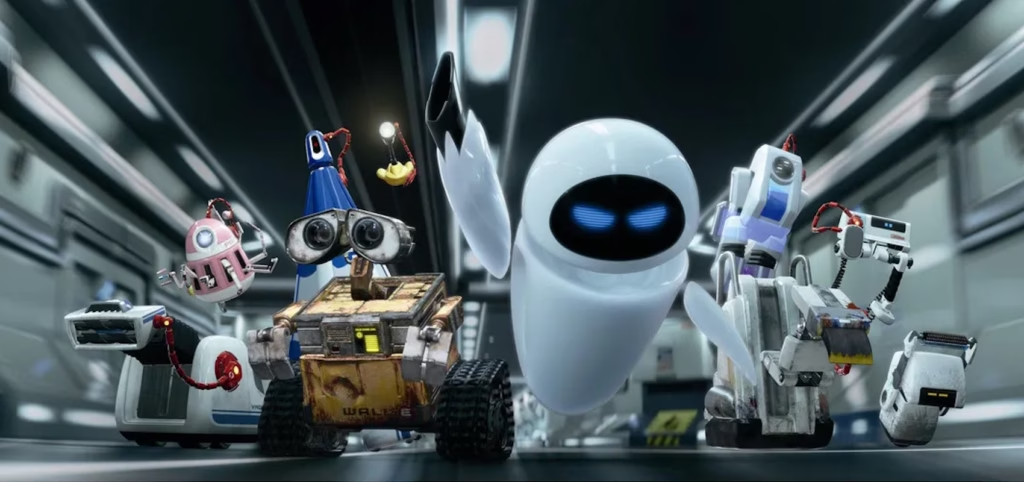
For me it started Pixar. Wall-E got the desktop because Wall-E was small, scuffed, and full of disproportionate ambition. EVA went on the laptop because she was sleeker and more capable and would absolutely judge Wall-E for the state of his cable management. Auto was reserved. Then the homelab proper kicked in and I needed something for the Ubuntu host that ran everything, and Pixar didn’t have a piece of infrastructure quite grand enough, so I went to the prime directive of the entire Wall-E film and just called it DIRECTIVE.
DIRECTIVE is in all caps because if you’re going to commit, commit.
After that the dam broke. The QNAP that handles torrents got called EVAcore, because the EVA name was already on a laptop that was getting outpaced and I needed somewhere to put the energy. The UGREEN NAS that took over media duties got called MeSeekBox, because at that point I’d watched too much Rick and Morty and the joke wrote itself – existence is pain to a Meeseek, and so is replacing a failing RAID. The VPS over in London is called AXIOM, which is the spaceship the humans live on in Wall-E, because by then I’d decided the production environment deserved the orbital station rather than the trash compactor. Its dev mirror is AUTO, because Auto is the autopilot, which is what dev environments should be, and also because AUTO doesn’t get to make decisions without AXIOM signing off.
The voice satellites went COMM-01 and COMM-02 because at some point you do have to come back to functional naming, otherwise you forget which pyramid base on which desk is the broken one.
Here is the thing nobody admits about this. It isn’t just nerd flavour. It actually makes the network easier to think about.
When I’m tailing logs at midnight and something is misbehaving, ‘AUTO is failing to fetch the bundle from OneDrive’ parses in my head instantly. AUTO is dev, dev pushes bundles, OneDrive is the relay, AXIOM picks up. I don’t have to look up a hostname or check a wiki. The name carries the role. When MeSeekBox starts grinding through a parity check it sounds exactly as long-suffering as the name implies, and that helps. When DIRECTIVE runs out of memory because I’ve stacked another container on it without thinking, the imperative tone of the hostname is itself a reproach.
You can do this with planets, with starships, with Greek myth, with characters from a book you read once at fourteen. The scheme doesn’t matter. What matters is that the names have shape. They sit in different categories. Ships and crew. Robots and stations. Captain and helm and engineering. The shape of the fiction lends itself to the shape of the rack.
I’ve never met a homelab person whose machines were called Server1, Server2, Server3 for any length of time. They start that way. They drift. By machine six they’re naming things after Iain M. Banks ships, or characters from Mass Effect, or Greek constellations, or Tube stations they like. The scheme finds them. They don’t find the scheme.
If you’re standing at the start of one – genuinely, sincerely, as someone who has been there – go with the universe you’d happily talk about for twenty years. Because in fifteen years’ time when MeSeekBox finally dies and you have to migrate its data onto something new, you are going to need a name for the new thing. And you are going to want it to feel like a continuation of the story, not a row in a spreadsheet.
NAS-2 dies in a drawer. Names that come from somewhere else outlive the hardware.