
I picked up an old ThinkPad at a charity shop in St Annes last summer. Twenty quid. T-something, early 2000’s maybe, with a keyboard that still felt better than any keyboard I’d typed on for fifteen years. I didn’t need it. I bought it anyway. It is sitting on a shelf in my office doing nothing useful and I look at it more often than I look at most of the things on that shelf that do work.
This is a problem.
The problem isn’t the laptop. The laptop is great. The problem is that I keep doing this. There is an entire branch of my brain dedicated to looking at chunky beige and black computing hardware from roughly 1990 to 2005 and going, yes, that. That’s what a computer should look like. That’s what a computer should feel like. Everything since has been a slow capitulation to the idea that hardware should look like it isn’t there.
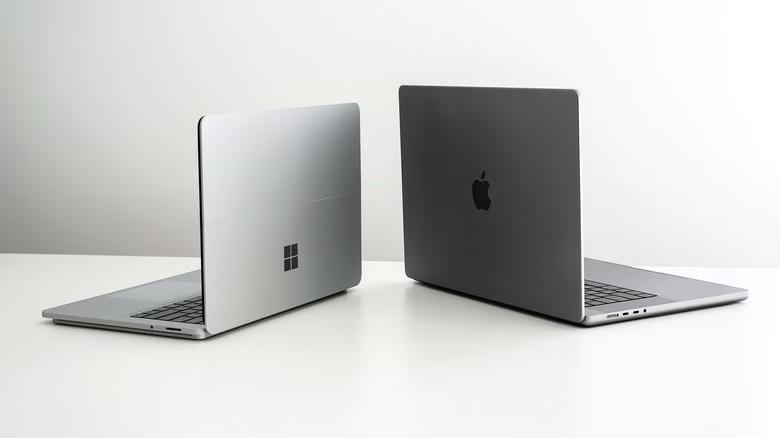
The current vogue is for the machine to disappear. Aluminium unibody, no visible screws, edge-to-edge glass, a single lozenge of metal so featureless it could be anything. A book, a chopping board, a very thin bar of soap. The design language explicitly wants you to forget you’re looking at a tool. The tool is just a screen now. The tool is just a window onto the cloud. The physical thing in your hands is supposed to be invisible.
Old IBM hardware did the opposite. It was loudly, unapologetically a computer. Black plastic case. Visible hinges. Slightly textured surfaces that didn’t show fingerprints. A small red dot in the middle of the keyboard that did all the work a trackpad now does, except your hands never had to leave the home row. Three different status LEDs telling you what the hard drive was doing because the hard drive was a thing that did stuff and you were entitled to know about it. Function keys with actual functions printed on them rather than abstract glyphs you have to learn.
The thing was a tool. It looked like a tool. It announced itself as a tool. And the design language of tool-ness extended down to details that nobody asked for and everyone benefited from. The little flap that covered the network port when you weren’t using it. The slot on the side that took a PC card, which I never had a use for, but which felt like having a port on your computer that connected to the actual future. The screen latch that clicked. The hinges that lasted. The keyboard, which I’m coming back to in a minute because I have to.
There was a way of doing things, embodied in those machines, that said: we expect you to use this for ten years. We expect you to upgrade the RAM yourself. We expect you to know what RAM is. We’re not going to glue anything together. We’re not going to solder anything that doesn’t need to be soldered. We’re not going to charge you a separate fee to access the inside of your own computer. Here is a Phillips screwdriver and a service manual that runs to four hundred pages, please don’t lose any of the small screws.
The keyboard is the bit that gets me every time. I cannot type on a modern laptop keyboard for long without my hands hurting. I can type on the ThinkPad on my shelf for hours and not feel anything. There is no magic to this. The keys travel further. They’re shaped to your fingers. The whole assembly is mounted on a steel plate so it doesn’t flex when you press hard. Modern laptops have abandoned all three of those things because they make the computer thicker, and the computer being thinner is the only metric that has mattered for about fifteen years.
Thinness is not a virtue. Thinness is a constraint. We have decided as an industry that the constraint is the virtue and built our hardware accordingly, and now everyone’s hands hurt and we blame ergonomics rather than the machines.
I am aware that I sound like a man fifteen years older than I actually am. I’m fine with that. Some opinions age you into them and this one aged me into it about a decade early.
There is a tiny resurgence happening, which is what gives me hope. The mechanical keyboard scene has dragged the conversation back to the idea that input devices should feel like something. Framework laptops are doing what laptops should always have done – parts you can replace, layouts you can change, an ethic of repair rather than disposal. The retro ThinkPad project from a couple of years back proved that there’s a market for people who’d pay actual money to get the old keyboard back. None of these is mainstream yet. But the idea is in the water again.
In the meantime my charity-shop ThinkPad sits on the shelf and the new Lenovo in the bag downstairs is the one I actually use, because that’s the deal you make. The aesthetic stays in the head. The work happens on the modern thing. And every few months I go and type a paragraph on the old one just to remember what it felt like when the tool was visible.
It feels exactly like I remember. That’s the worst part.