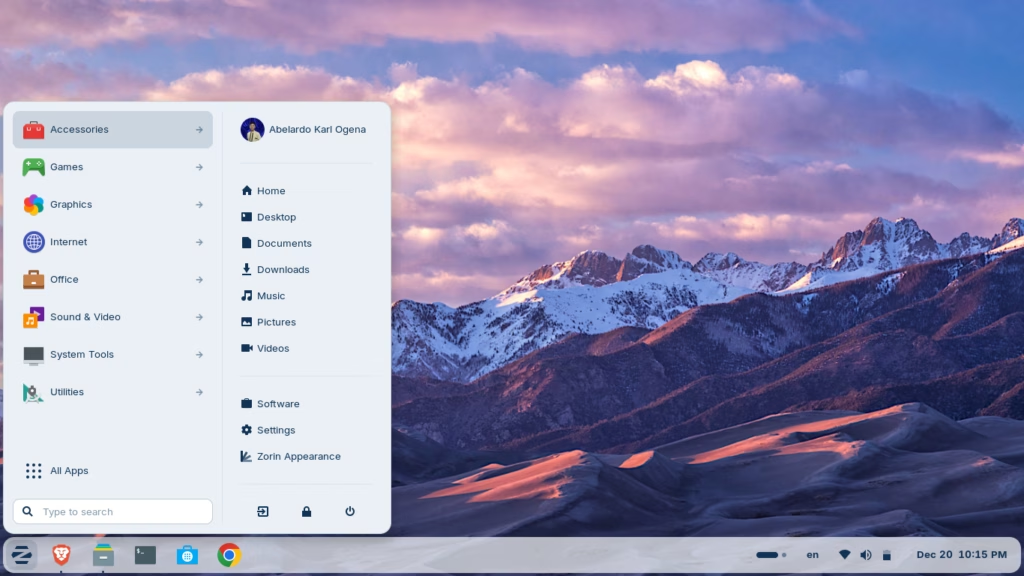
I wiped Windows. Not partitioned around it, not dual-booted with a get-out clause, not ‘I’ll just try it on a spare drive and see how I feel’. Formatted the boot drive on WALL-E, installed Zorin OS Pro, and committed. The Ryzen 5 5600X, the 4060 Ti, the 64GB of RAM, all of it on a fresh Ubuntu base wearing GNOME like it meant it.
That was February. I’m writing this from Windows.
The reason I went all-in is that ‘try Linux on a spare partition’ is the version of the story that never works. You install it, you boot into it twice, you remember that all your actual tools are on the other partition, and you stop bothering. Either the workstation is a Linux machine or it isn’t. So I made it one.
Zorin Pro was the pick for boring reasons. Ubuntu underneath, which I know my way around. GNOME on top, which I don’t mind. A paid-for distribution that supports the project and gives you the proper layout options out of the box – the Windows-style taskbar, the macOS-style dock, the everything-tiled one – without having to fight extensions. I paid for it. About £40. If a distro is going to be the OS I live in, the developers can have £40.
Secure Boot stayed enabled. That meant signing kernel modules for the Nvidia driver and a couple of other bits manually. Annoying once, sorted once. The Nvidia situation on Linux has improved out of all recognition; the driver was fine, the framerates were fine, the only price was the signing dance on install.
What surprised me was how quickly it just became my computer. apt for installs, a real terminal as a first-class citizen, a file manager that doesn’t decide to index every directory I open, an OS that didn’t slip a OneDrive ad into the start menu the week after a feature update. The small things stop being remarkable and start being normal. That’s the bit nobody writes about. Not the conversion moment, not the failure mode, but the boring middle where the OS just works and you forget you’re running it.
I added a Vosk-based STT setup that bound system-wide speech-to-text to Ctrl+Alt+S, dictating into any text field via xdotool. That has its own post coming, so I’ll leave it there. The relevant thing for this one is that it made the machine feel built rather than installed. Tools that fit your hand. The Linux desktop rewards that kind of fiddling in a way Windows actively punishes.
So what went wrong.
WALL-E runs a multi-drive setup. Not a small array off in a cupboard, a working RAID inside the chassis, holding project archives and the kind of media I want fast local access to. And something in the way Zorin (or, more honestly, the kernel underneath Zorin) handled drive enumeration on boot started getting inconsistent. Sometimes the array mounted cleanly. Sometimes it came up degraded. Sometimes the machine booted to a black screen and I had to drop to a recovery console to work out why.
I reinstalled Zorin. Same problem. I dug into kernel logs, prodded at mdadm, tried a different mount strategy, considered whether I was looking at a hardware fault and concluded I probably wasn’t because Windows handled the same drives without complaint. Somewhere in the specific combination of motherboard firmware, kernel version, driver, and array layout was the answer. I couldn’t get to it in the time I had.
That’s the bit that matters. Not ‘Linux is broken’. Linux isn’t broken. Plenty of people run RAID on Linux without ever thinking about it. The issue was my particular pile of hardware on my particular kernel doing something neither of us could explain in the hours I had to spend on it. The fix was probably a one-line config change buried in a forum post I never found.
I gave it three weeks. Then I gave up. Windows 11 Pro key, formatted, started again. The work has to happen. The OS has to stay out of the way enough for the work to happen. Windows is, on balance, fine at this. It’s also fine at quietly reorganising the start menu, suggesting I sign in with a Microsoft account every other week, and assuming I’d like Copilot to write my emails. You take the package.
I miss apt. I miss the file manager not trying to be helpful. I miss the terminal feeling like part of the OS rather than a guest. I don’t miss the RAID problem.
Will I try again? Probably. Bazzite is interesting. Pop!_OS 24.04 should be properly stable soon. The door isn’t closed, it’s just propped open with a slightly more realistic understanding of what a daily driver swap costs in time.
The honest answer to ‘is Linux ready for the desktop’ is that it’s been ready for years for some people and will never be ready for others, and which one you are depends entirely on what your specific hardware does when you ask it to do the thing. Mine did this. Yours might not.

The Adobe situation is a footnote. Affinity covers most of what I need for personal work. Adobe CC on Linux through compatibility layers exists, but I run client work on this machine, and ‘works most of the time’ is not a tier I’m willing to ship from. That alone would have kept me on Windows for the BOE side regardless. The RAID thing just got there first.
WALL-E is back on Windows 11. The 4060 Ti doesn’t care. The work happens.