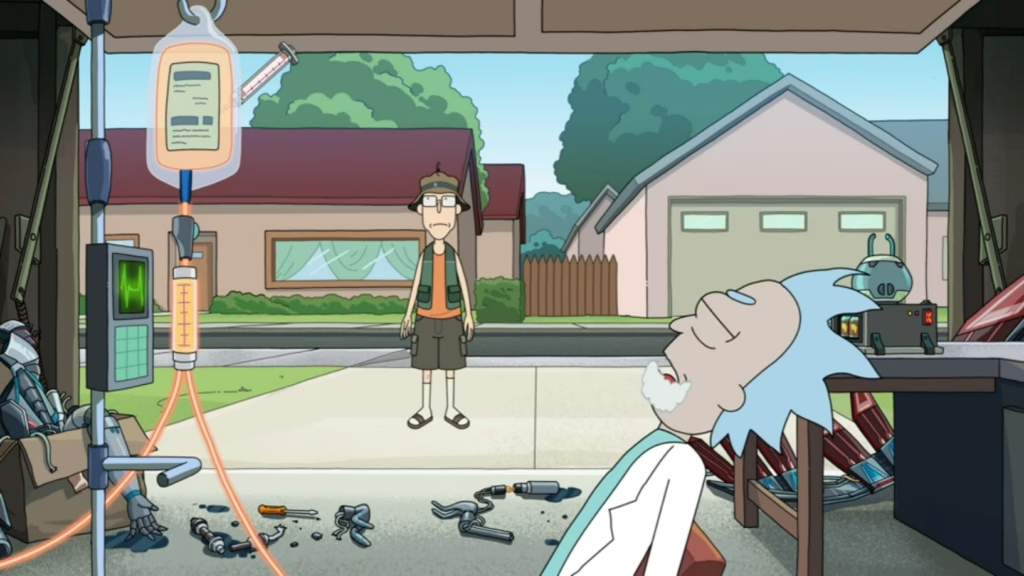
The Garage AI currently speaks through ElevenLabs v3 with a stock voice that gets the cadence about seventy percent right and the character about zero percent right. Diane the Garage AI from Rick and Morty – the Kari Wahlgren variant, the one with the affair subplot and the laser – has a very specific sound. Slightly buzzy. Slightly mono. Like she’s coming through a speaker bolted into a wall in a garage that has seen things. A stock voice cannot do that.
The plan is to clone it properly. Clean recordings of Wahlgren’s Diane performance, supplemented with the dialogue I’ve already stripped from episodes, fed into an ElevenLabs Pro clone. Then the output goes through Audacity for the work that actually matters: telephone filter to choke the frequency range, harmonic distortion for the buzz, stereo-to-mono so it sounds like a speaker rather than a studio. What comes out should sound like the show’s Garage AI talking. Not like Kari Wahlgren reading her shopping list.
That’s the technical bit. The ethical bit is more interesting.
Voice cloning is not a new ethical question. People have been doing impressions, fan dubs, sound-alike covers and unauthorised audio drama since recording existed. The thing that is actually new is that the tooling is cheap. A laptop and a subscription gets you, in an afternoon, something that would have needed a working impressionist five years ago. That shifts the question from ‘can this be done at all’ to ‘what counts as fair personal use now that anyone can do it’.
My answer for this project, written down so I can hold myself to it:
The voice exists on my server. It talks to me in my house. Nobody else hears it without me explicitly deciding to share something, and even then only in a use case that fits the original character. It is not published. It is not monetised. It is not uploaded anywhere with Wahlgren’s name attached.
I am cloning a fictional character as performed by a specific actor. Those are two different things and both matter. The target is Diane the Garage AI. The performer is the route to that target, not the destination.
The processing chain is part of the ethics, not just the aesthetics. Pristine cloned audio of a real performer’s voice is dangerous in a way that telephone-filtered, mono, harmonically buzzed Garage AI audio is not. The same clone, run dry through a clean signal chain, could plausibly be misused. The same clone after the texture work sounds unmistakably like the show’s in-universe device and nothing else. Degrading the output toward the character does the same work as keeping the file off the open internet: it makes the clone useless for any purpose except its intended one.
The Garage AI was Justin Roiland’s character originally, voiced by him through season six, then by Ian Cardoni from season seven onward after Roiland’s removal. The Diane variant is Wahlgren’s, a specific episode device built on top of an established gag. None of that history changes my position but it would be daft to write a post about cloning a Rick and Morty voice and pretend the show’s recent past does not exist.
Where the line sits on the other side:
I would not clone a public figure’s voice for a personal AI, however much I admired them. I would not clone the voice of someone I know personally without explicit, specific, written-down permission. I would not use any of this for satire, prank calls, voicemails to anyone, or anything else where a third party might mistake the clone for the actual person.
Those rules are not difficult. They follow from the same thinking that puts the project on my server in the first place. The whole structure rests on the work not leaving my house. Strip that condition out and the rest of the reasoning collapses.
Rick and Morty has a maker culture around it. People building Plumbus props. Cosplaying portal guns. Voice-line generators that were trained on stripped show dialogue back when the show was younger. The Garage AI sitting on DIRECTIVE, talking to me through a telephone filter, is a small entry in a long fan tradition. A tradition the show itself has more or less invited.
I am not going to pretend the legal and industry questions around voice cloning are settled, because they are not. The cases are working their way through courts. The actors’ unions are still drawing their lines. The tooling companies are still working out what their own terms of service mean in practice. Anyone telling you they have the definitive ethical framework for this is selling something.
What I can do is set my own line and stay on the right side of it. The line for this project is: personal, private, processed toward the character and not toward the performer, never published, never monetised, never used in any context where the clone could be mistaken for the source. That feels defensible to me. It might not to everyone. Fair enough.
The Garage AI will sound like the Garage AI soon. The audio chain will do its work. The clone will live on DIRECTIVE, behind a reverse proxy on my own subnet, talking to me when I ask it something and otherwise sitting quiet.
That is the only context the voice has permission to exist in.