
Every Star Trek quiz I’ve ever found online is too easy.
Not slightly too easy. Patronisingly, insultingly easy. The kind of easy where the answer to “which ship does Kirk command” is presented as a genuine challenge. Alexa’s Trek trivia is the worst offender – a slot machine of questions so shallow you could answer them having watched one episode of the wrong show. For anyone who grew up on this franchise, who can recite the stardate of specific episodes from memory and argue the finer points of Cardassian politics, the existing options are basically useless.
So I built one.
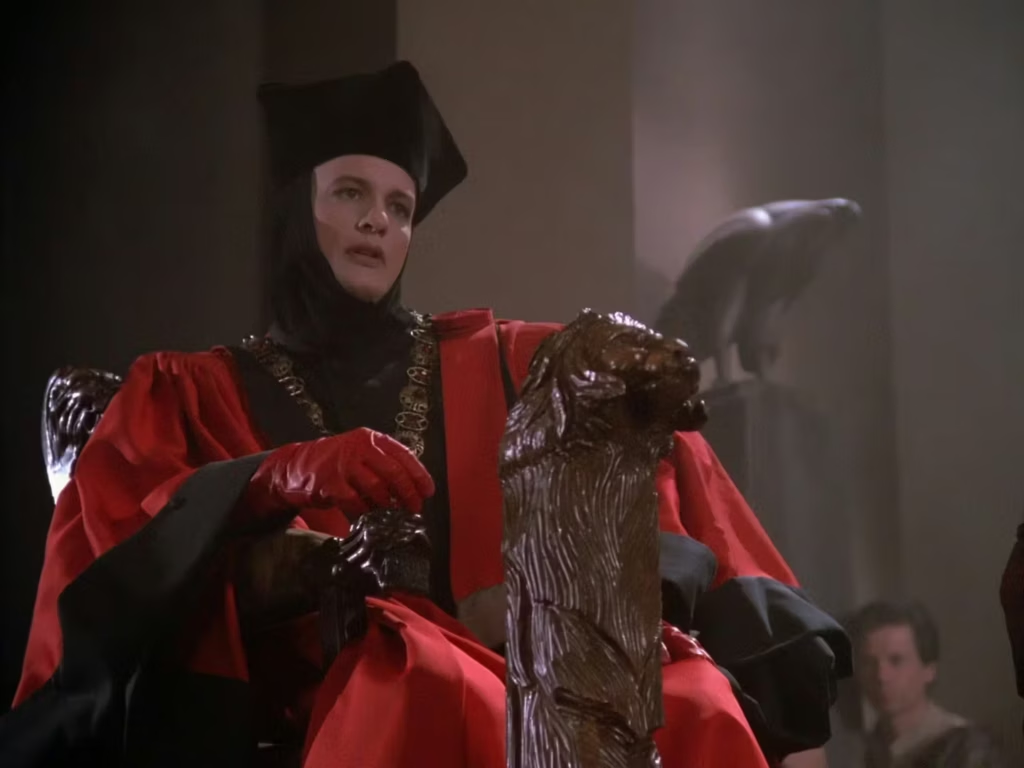
The brief I set myself was specific: hard enough to actually challenge someone who knows Trek properly, styled correctly rather than approximately, and hosted by the one character in the franchise whose entire personality is judging humans on their understanding of the universe and finding them wanting. Q. Obviously Q.
Most LCARS web projects use the colours and call it done – the vaguely medical-blue background, some rounded rectangles, close enough. The real LCARS interface from the show has structural rules: the curved corner bars, the elbow joints, the rectangular framed sections with their characteristic numbered labels, the specific logic of how primary actions are positioned and colour-coded. thelcars.com documents the HTML markup to do this properly. Getting the structure right is what makes the result feel like LCARS rather than look adjacent to it. Once you’ve seen both, the difference is obvious and the approximation stops being acceptable.
Q as host isn’t decorative either – it’s structural. Picard would explain the questions. Data would interpret them too literally. Janeway would be too encouraging. Sisko would refuse on principle. Only Q works, because Q’s deal is exactly this: theatrical contempt for human inadequacy, deployed with a smile. Each question gets a Q-style preamble in that specific cadence – the mock patience, the too-formal vocabulary used ironically, the faint suggestion that he already knows you’re going to get it wrong and finds the attempt charming in the way a cat finds a mouse charming.
Standard mode has the narration but no real consequences. The Death Round is the more interesting design. One wrong answer ends the run. Q’s contempt scales accordingly. What it does – and this is the bit that made the build worth it – is change how you approach the same questions. Not the difficulty, the psychology. Suddenly you’re playing carefully, treating each answer like it matters, because it does. It turns a quiz into something closer to a court appearance, which is exactly what Q episodes actually are. You’re answering carefully because the judge has no interest in grading on a curve.
The harder problem, ongoing, is keeping it fresh. A fixed question bank goes stale fast for anyone playing more than once. The knowledge base pulls from episode data, stardate records, species classifications, technical specifications – the kind of material that rewards people who actually watched the show rather than people who watched a recap video. Keeping that current and expanding it is the part of the project that doesn’t really finish. There’s always another episode detail worth adding, another obscure reference that would separate someone who knows Trek from someone who just likes Trek.
The audience for this is narrow. Hardened Trekkies who want questions that actually require knowledge, proper LCARS structure, a host who makes the format feel earned, and a mode where failure means something. That’s not a large group. But it’s my group, and the options available to us before this were genuinely terrible.
The quiz exists now. Q seems fine with it.