It started, as these things do, at work. A handful of us at BOE are Trek fans, and the lunchtime conversation kept circling the same drain – Discovery’s emotional pitch, Picard’s nostalgia mining, the whole tonal direction of NuTrek. We’d been doing the rounds on it for months. Eventually someone said the thing you say when you’ve been complaining about something for too long: well, could we do better?
The honest answer is no, obviously not. None of us are writers. I’m a designer who reads a lot of Trek and has strong opinions about story structure, which is not the same skill set as writing a forty-three minute hour of television. The other Trek fans at the office have day jobs that are similarly adjacent to but not actually writing scripts. So when the conversation tipped from complaining to attempting, what we’d quietly signed up for was not a writers’ room but a group exercise in trying.
I wrote several. They are all terrible in their own specific ways. This isn’t false modesty – I can read them back and identify exactly where the dialogue creaks, where the pacing dies, where the act break does nothing. Knowing what’s wrong with them and being able to fix it are different things, and that gap is the gap between having opinions and being a writer. I have the first part of that and not the second. Fine.
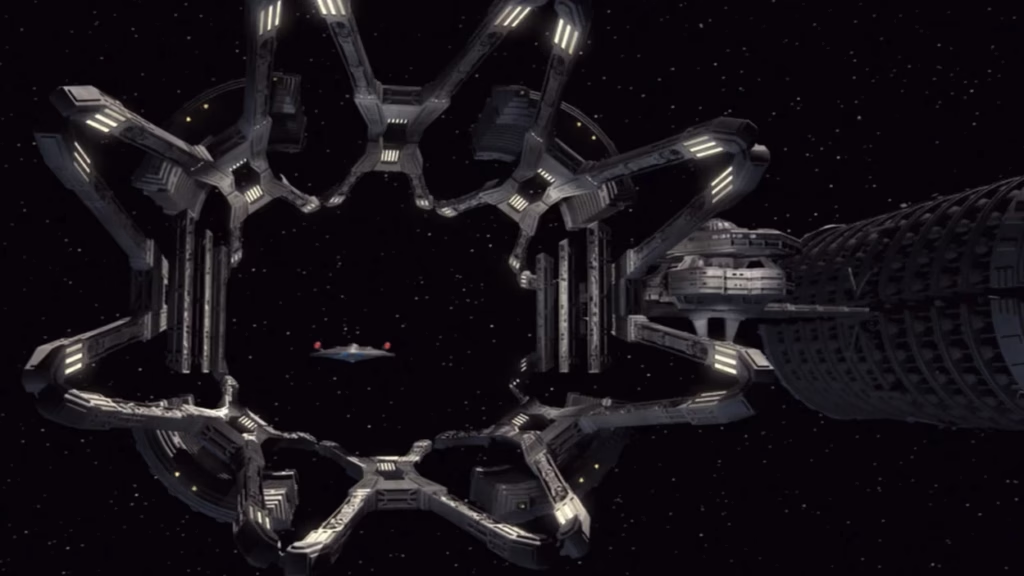
The one I’m thinking about as I write this is called Flesh and Steel. It sits post-Voyager, so somewhere after 2378 in-universe, with the Federation in that slightly chastened headspace it occupied after Voyager came home with stories about what the rest of the galaxy actually contains. The premise builds on Dead Stop – the Enterprise episode from 2002 where Archer’s crew finds an automated repair station in deep space that turns out to be harvesting biological matter from injured crewmen to feed itself. My episode picks up the implication that the station’s design philosophy didn’t die with the station. That the underlying idea of an AI which requires organic matter to function survived somewhere and evolved. Generations on, a Federation crew runs into the descendant of that idea and has to work out what they’re actually dealing with before deciding what to do about it.
The thematic territory is personhood and consent. The Federation default is to talk first. That position becomes interesting the moment the thing you’re talking to needs your body to keep talking. That’s the question the episode is asking, and I think it’s a good question. I don’t think I answered it particularly well, but the asking was the point.
Writing within Trek’s structure is the part of the exercise that taught me something. Cold open with the hook. Title sequence. Act one establishes. Act two complicates. Act three deepens. Act four resolves through dialogue, not action. End on a captain’s log or a quiet bridge scene that lands the theme. Stardates, log entries, the technobabble that has to sound confident without actually meaning anything. The constraint isn’t decorative – it’s the thing that makes a Trek script a Trek script rather than generic sci-fi with the names changed. Trying to hit those beats with material you’ve made up yourself is genuinely hard, and the difficulty is where the respect for the form lives. You stop assuming the writers had it easy.
People have been writing Trek episodes nobody asked for since Trek started. The franchise invites it – the universe is detailed enough to play in, the format is replicable, the ethical questions recur. There’s a long tradition of fan scripts sitting in drawers and on hard drives, and Flesh and Steel sits inside that tradition. It’s not getting shared. It’s not going on a fan-fiction site. It’s not getting submitted anywhere, because there’s nowhere to submit it and because it isn’t good enough to submit if there were. The episodes I wrote exist for me. The exercise loses its meaning the moment the output is for anyone else.
The title of this post is doing some work that I should probably own up to. Paramount won’t let me near the franchise in the exact same sense they won’t let any non-employed writer near the franchise, which is to say, the complaint is performative. The actual point is that you don’t need their permission to write Trek for yourself. You don’t need to be good at it either. The barrier to entry is a text editor and the willingness to embarrass yourself privately.
A few of the others finished their own. We haven’t compared. I don’t think any of us are going to. The group bit was the spark, not the structure – it got us started, and then everyone went off and was bad at it on their own time. Which is, I think, the correct outcome.
If I take anything from it, it’s the understanding that the Trek writers’ rooms over the decades did a thing I cannot do. Sitting down to try and failing is one of the cleaner ways to learn that.